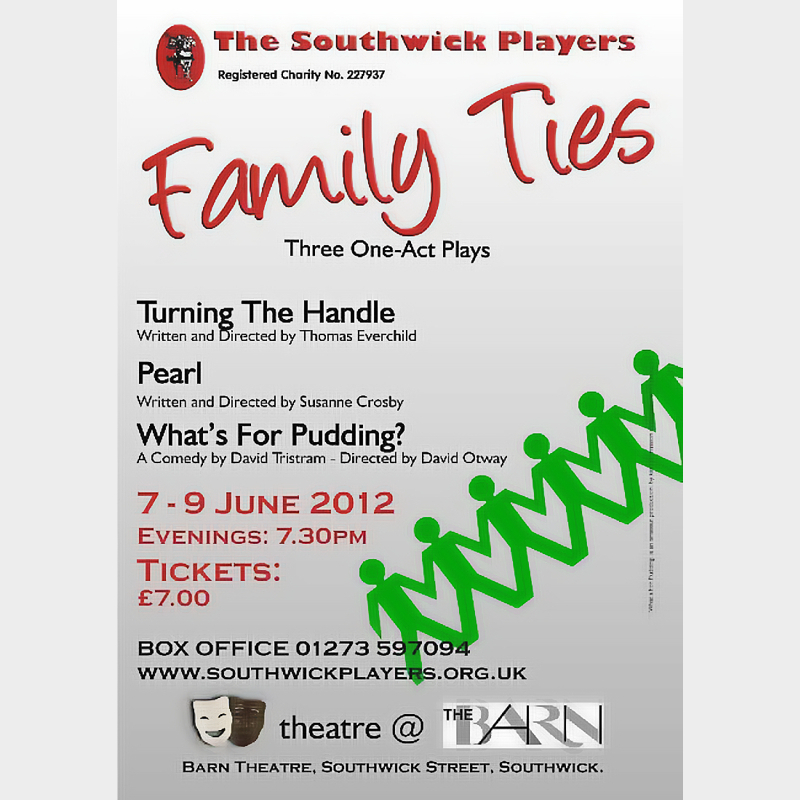

Turning the Handle (Barn Theatre)
Writer/Director: Thomas Everchild
Performer: Philippa Hammond
FULL REVIEW
One-act plays are the theatrical equivalent of a short story and require the same rules to work. Character and plot development must rely on established shorthand and the drama needs a twist. In the monologue Turning The Handle, Philippa Hammond portrayed an artless Edwardian lady recalling life and love in front of an early cinematograph, apparently never quite realising the effect of loosening draperies on her audience. It was a charming solo turn, written and directed to be beautifully out of kilter by Thomas Everchild.
The Argus
Louise Schweitzer

The Trials of Colonel Barker (Rehearsed Reading at Purple Playhouse)
Writer/Producer: Rose Collis
Director: Thomas Everchild
Performers: Rose Collis, Keith Drinkel, Philippa Hammond, Guy Wah
Supported by The Arts Council
FULL REVIEW
A highly enjoyable script-in-hand performance skilfully brought to life this amazing true story. The play twisted and turned with pace, humour and pathos and I loved the framing device of the sideshow where Barker and ‘wife’ exploited their notoriety. I was impressed too by the objectivity and complexity in Colonel Barker’s portrayal, letting us decide for ourselves if she was a con-woman or victim of gender/sexual discrimination.
Sussex Playwrights Reviews
Judy Upton

Romeo and Juliet (Shoreham Wordfest)
Producer: Philippa Hammond
Director: Thomas Everchild
I recommend this production of Romeo and Juliet without reservation, and I will look out for further productions by Afterthought Theatre. It’s professional, true to the original text, and fun for all involved.
(Fringe Guru)
This charming version of the classic teenage romance offers fine characterisation, and lots of fun besides …
This production of Shakespeare’s Romeo and Juliet will not fail to charm. Every actor gets inside the skin of their character, and their zest for life is evident from the first scene of this love story set in Verona…
Playing Juliet, Olivia Sewell has great presence and passion … sincere and courageous …
John Black is convincingly earnest as Romeo, always love struck, consumed by Cupid’s arrows to the heart …
The high standard of acting is supported by excellent direction from Thomas Everchild …
I recommend this production of Romeo and Juliet without reservation, and I will look out for further productions by Afterthought Theatre. It’s professional, true to the original text, and fun for all involved. Expect a teenage romance and you won’t be disappointed.
Fringe Guru
Roz Scott

Protect and Survive (Brighton Festival Fringe)
Writer: Jonathan Williamson
Producer: Simon Moorhead (TBC Audio)
Director: Thomas Everchild
Actors gather in a recording studio to record a radio drama set in a country suffering the after-effects of an atomic war.
Protect and Survive is also a witty, enjoyable show. The key to that lies again in the clever concept: because we’re watching a play being recorded, we get to see the actors bantering, squabbling, and occasionally snogging between scenes. The observations and the thespian in-jokes are very sharp indeed, and the (real) actors all draw their (fictional) characters with enough detail to make us care.
(Fringe Guru)
Protect and Survive (Brighton Festival Fringe)
Writer: Jonathan Williamson
Producer: Simon Moorhead (TBC Audio)
Director: Thomas Everchild
If you remember the Eighties, you probably remember Protect and Survive – a notoriously grim government pamphlet telling citizens what to expect during a nuclear war. This intelligently-constructed play recreates some of that Cold War terror, and reminds us of a truth we seem in danger of forgetting: that there are still weapons against which we cannot protect, and wars which we cannot survive.
The horror of the hydrogen bomb would be impossible to recreate on stage, and Protect and Survive is wise enough not to try. Instead, very cleverly, we see the recording of a radio play; unashamedly modelled on genuine TV dramas like The War Game and Threads, the story surrounds the collapse of civilisation in the aftermath of nuclear war. As the actors gather round microphones, they rehearse selected scenes from their performance scripts – a gambit which offers playwright Jonathan Williamson the perfect licence to skip to the darkest moments in his plot.
It also provides an excellent excuse for some shameless exposition, as director Cat – under the guise of briefing her actors – fills us in on exactly how radiation poisoning eats the human body from inside. This has to rank as one of the smartest devices I’ve ever seen at the Fringe, and on the whole it works remarkably well – although there were a handful of occasions when I felt Cat’s interjections interfered with, rather than contributing to, the action on stage.
The scenes we see are uncompromising, and powerfully delivered by a uniformly compelling cast. Even though this is notionally a radio play, there’s enough physicality to maintain our interest, and to capture the increasing brutality as society degenerates from brutal martial law to unrestrained feral disorder. It’s all interspersed with genuine quotes from the original Protect and Survive public information films – a periodic warning that what we’re seeing is not a fanciful horror story, but a realistic scenario our country once prepared for.
So it’s surprising to note that Protect and Survive is also a witty, enjoyable show. The key to that lies again in the clever concept: because we’re watching a play being recorded, we get to see the actors bantering, squabbling, and occasionally snogging between scenes. The observations and the thespian in-jokes are very sharp indeed, and the (real) actors all draw their (fictional) characters with enough detail to make us care. It all adds up to a counterpoint to the bleakness, a continual reminder of the flawed but vibrant world a nuclear war would destroy.
A year ago, you might have questioned the value of resurrecting this distant slice of Cold War history; but with bellicose rhetoric increasing across the Atlantic, it doesn’t feel so distant any more. Referring to Threads, Neil Kinnock once said that the story of a post-nuclear society needs to be told time and time again. This particular telling is a worthy response to that still-relevant call.’
Fringe Guru
Richard Stamp
Protect and Survive (Brighton Festival Fringe)
Writer: Jonathan Williamson
Producer: Simon Moorhead (TBC Audio)
Director: Thomas Everchild
Cast: Tigger Blaize, Philippa Hammond, Justin K Hayward, Jack Kristiansen, Penny Scott-Andrews, Amy Sutton
Six actors re-create… actors and managers. Pippa Hammond’s Director Cat is like Sutton a perfectly-cast, cast-ingot actor, managing actor panic, sponsorship crises and sexual intrigue with charismatic Theo whom she’s addicted to though married to off-stage Charles. Her exchanges with Ashley are a high-point of naturalistic dialogue and wit.
(Fringe Review)
Protect and Survive (Brighton Festival Fringe)
Writer: Jonathan Williamson
Producer: Simon Moorhead (TBC Audio)
Director: Thomas Everchild
Cast: Tigger Blaize, Philippa Hammond, Justin K Hayward, Jack Kristiansen, Penny Scott-Andrews, Amy Sutton
Imagine it’s three minutes to midnight before a nuclear winter. And that’s slipped on January 26th this year to two-and-a-half. Jonathan Williamson’s created a laconic take on the old 1970s-80s nuclear holocaust warnings directed by Thomas Everchild under the auspices of TBC Audio and Simon Moorhead’s production – who also supply the radio studio set with some fine lighting effects.
Protect and Survive re-imagines the period re-enacted in a 2017 Brighton studio with actors recreating the feel and scare of the times – including digitalized re-tracings we’re told on old C90 tape and back again which produces the acronym DAD. It’s almost nostalgic, then a little bit not. The scenario as presented before arrival suggests real events take over. That doesn’t happen which is a pity.
St Andrews is a generous venue, and the set’s convincingly constructed. Sound engineer Ashley (Amy Sutton) encourages the audience to produce sound effects of screams and cries of ‘food’ and ‘give us some food’ recording all in bytes before racing off to the mixing cabin. It’s an excellent participation gambit and ought to be repeated. Throughout this, Sutton’s acting as the unflappable precise laid-back sound engineer who sees everything is one of the production’s chief delights.
Six actors re-create… actors and managers. Pippa Hammond’s Director Cat is like Sutton a perfectly-cast, cast-ingot actor, managing actor panic, sponsorship crises and sexual intrigue with charismatic Theo whom she’s addicted to though married to off-stage Charles. Her exchanges with Ashley are a high-point of naturalistic dialogue and wit.
Ashley’s a quietly loyal enabler, often stingingly accurate in assessing everyone including a light-touch critique of Cat’s fixation on Theo: she doesn’t trust him, hinting she’s discovered an inadvertent recording of their lovemaking. Given adults themes are highlighted I half-expected this to burst on us at an inopportune moment in the recording process. Perhaps it should. There’s an Ayckbournesque potential in this narrative that isn’t quite tapped.
Like Ashley a ‘creative’ Cat exudes quick-witted, sure-footed poise tip-toeing emotional holes and catty Saffron’s barbs aimed at everyone, particularly Julia and Peter and hints at Cat’s affair. Even Theo’s trips to the toilet (coke?) are spun as STD. Penny Scott-Andrews’s Saffron exudes an edgy nastiness contrasting with in-character vulnerability of a child-like order.
Tigger Blaize playing Julia portrays a less glamorous right-on type born of a Greenham Common mother. Despite Saffron’s attempts to suggest Peter might be her father (being an old CND type) Blaize creates a niche of jobbing actor with the inverse of Saffron’s pretensions.
Justin K Hayward’s previous life included being lance-carrier for Kenneth Branagh in Hamlet. ‘He never called for me again: too much competition.’ Theo-besotted Cat demotes Peter from one role but leaves him as old-style BBC announcer. His deadpan punctuations under spectral lighting renders him a kind of spectral visitor, studding the performance. Shadowy vulnerability is etched on his bow tie and formal garb.
Jack Kristiansen’s Theo promises well, though doesn’t get the opportunity to deliver the danger his character’s set up to. The plot envelope of jobbing actors creating a radio programme is an extremely promising one not fully realized here, given the six characters are well-delineated with actors well-equipped to portray them.
The various scenarios presented, progressive horrors facing dying and endangered survivors of nuclear fall-out, are well wrapped as Cat and Ashley co-ordinate, cajole and occasionally re-take scenes: a progressive falling-apart of humanity over several months, detailing physical decay, ending in death by septicemia, rape and delivery of a child on a women-led commune.
One highlight arrives as those very cries we enacted for the boom are fed together in a scene where the army captain (Theo) directs his men to fire tear gas canisters directly into the crowd killing some, to prevent their reaching army-hoarded food. They’re trampled. Superb as this scene is, especially in this generous acoustic, characters’ dialogue is lost. Overall, though, this conveys a densely informed, terrible topic in a potentially ideal format: the bustle of studio-acting politics. Such a non-preachy manner needs more narrative to bounce off. Alistair Beaton’s recent Fracked! subverts untreated info by guying it or edging into the mouths of characters from both sides who develop half-lives of their own. Williamson’s clearly inspired by similar instincts and needs to give himself permission.
On the opening night some technical issues only slightly delayed the performance. The ‘recording’ sign stayed stubbornly on throughout. Everchild knows his business and the whole piece moves seamlessly with no longueurs at all.
This is still a work-in-progress, needing more time to unfold – at least another ten-to-fifteen minutes – so characters’ sub-plot can breathe. The conclusion’s an aptly abrupt dismissal. The rest of the cast show their backs, as the dead, an unnerving bit of theatre business designed to occlude the baldness of the ending.
See this work for its outlined imagination, facts, most production values and acting. Just as nuclear bombs suck out the air from everywhere around it, this intriguing, often beautifully produced and certainly consummately-acted work just needs to breathe back some of that air.
Fringe Review
Simon Jenner
The Neverland Singularity (Short Plays at The Barn Theatre, Shoreham)
Writer/Director: Thomas Everchild
Performers: Philippa Hammond, Thomas Everchild
FULL REVIEW
Appearing in The Neverland Singularity [which he also wrote], Thomas Everchild played a taxi driver taking a scientist to a conference . Stuck in a traffic jam he tried to engage his fare in conversation which ranged from evolution and the existence of God to physics. With Philippa Hammond as his hapless passenger they provided extremely good comedy.
The Argus
Barrie Jerram
The Neverland Singularity (Sussex Playwrights Short Plays)
Writer/Director: Thomas Everchild
Performers: Philippa Hammond, Thomas Everchild
It’s a perfect ten-minute play, ideal for radio like Lancefield’s. Lighter by far in tone, it’s packed with clever interrogatives and leaves us a bit more enlightened on astral physics as well as cultural sexual politics.
(Sussex Playwrights Reviews)
The Neverland Singularity (Sussex Playwrights Short Plays)
Writer/Director: Thomas Everchild
Performers: Philippa Hammond, Thomas Everchild
You know I had that Bertrand Russell in the back of my cab once, and I asked him well what’s it all about, and you know he couldn’t tell me.’ Maybe it’s urban myth out of stand-up; it probably happened.
There’s a couple of 2005 radio plays by poet Sean O’Brien exploring that perennial British fantasy: a working cabby or labourer confronted with a philosopher who then doesn’t just out-argue them, but shows a thorough knowledge and grounding in their works.
Whilst the mythical cabby pops the question our common sense wants to ask of inductive reasoning, and trounce it, O’Brien takes his cues from historical events. Everchild delights in that perennial the cabby bit does something else again: brings a sexual dynamic: man-in-the-street put-down meets chat-up.
Philippa Hammond is beautifully priggish, asking directions to the conference. Everchild works this out, the science one. He begins questioning Hammond simply, and Hammond does a fine job of registering off-hand impatience gradually assaulted by Everchild’s gift of chirpy petulance, nagging and irritating Hammond into losing her temper but not her reason: she can’t shut down the cabby’s maddening rationality. Each question builds up questions of stellar singularities and astro-physics, which Everchild increasingly shows he understands well in outline. Hammond’s character drops hauteur for mild outrage, but is hooked; her training, initially dismissive of stupid questions, can’t cope with left-field informed ones. This sparring reaches a catharsis and an unexpected (hoped-for) conclusion.
It’s a perfect ten-minute play, ideal for radio like Lancefield’s. Lighter by far in tone, it’s packed with clever interrogatives and leaves us a bit more enlightened on astral physics as well as cultural sexual politics.
Sussex Playwrights Reviews
Simon Jenner